Every week, we hear stories from committed family carers doing their absolute best—often under enormous strain. One of the most common issues we see? The right intentions, but the wrong equipment.
In this edition, we share Rodney and Emily’s story—one that highlights what can go wrong when equipment is purchased without specialist input, and how much can be achieved with the right support and guidance.
At BodyRight Healthcare, our goal is simple: to help you, as Case Managers, deliver sustainable care strategies that reduce risk, ease the burden on carers, and allow clients to stay at home safely for as long as possible. That’s why we’ve created Lift Less Solutions, the Manual Handling Training and Occupational Health & Safety Advisory arm of BodyRight Healthcare.
We hope this story sparks conversation and gives you fresh confidence that the right equipment—matched with the right advice—can change everything.
NAMES CHANGED FOR PRIVACY PURPOSES
“I could feel myself getting more and more tired, but what else could I do? I needed to care for my husband” – EMILY
How Did We End Up Here?
Rodney is 79 and has been bed bound for the past two years. He developed a spinal cord injury in the late 1990s following surgical and radiation therapy for a tumor that was residing in his spine at level C2-C3. Two years ago, Rodney had a heart attack, which in turn led to a stroke. This resulted in a right hemiplegia with loss of function, flaccid paralysis and poor motor control of his right upper and lower limb. Since that time he has spent most of his days in bed, only ever leaving to use the bathroom or for a shower. His wife Emily is his primary caregiver, providing assistance for ADL & PADL tasks throughout the day. She is assisted by several personal care workers and a local physiotherapist who attend at least once per week. The provision of these services is funded through Rodney’s Home Care Package.
This is Not a Dress Rehearsal
Since Rodney’s heart attack, his mobility and capacity has slowly declined to the point where he can no longer walk, stand or even weight bear. Emily reported to her CM that she was having increasing difficulty transferring Rodney in and out of bed, and to his commode. Despite having a hospital-like bed that has multiple adjustable functions, a shower commode on wheels to assist with showering and toilet requirements, it was still very difficult. Rodney, who weighs over 85kgs, could not support his own body weight and was very restricted in his personal capacity to assist with any transfers. They had some equipment but not the right equipment.
This scenario was the scene before a potential major incident occurred!
This is where the issue arises. After completing his shower, Rodney needs to be transferred back into bed. However, the lowest bed height is still higher than the height of the shower commode, so all transfers back into bed are uphill. Emily reports that to get Rodney back into bed, she has to physically support and lift him through the entire transfer. Over time, Emily’s body has been subject to significant physical stress and fatigue, eventually she will either wear out or sustain an injury. She is not only caring for Rodney but has her own health problems as well.
Emily and Roger purchased a Standing Patient Lifting Machine, out of their own savings to help Emily with the transfers.This was several years ago and unfortunately Rodney’s capacity has deteriorated. It helped for a little while, but now Rodney is unable to weight bear and they are unable to use it. The correct guidance and advice, would have certainly steered them to a different outcome. At this point, Emily is now doing all the heavy lifting–literally–and placing herself and Rodney in high risk scenarios every single day.
Sometimes people just don’t know, what they don’t know.
The Right Result
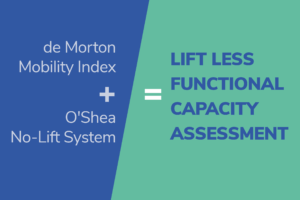
What sets Lift Less Solutions apart from the others providers, is the nature and design of our Functional Capacity Assessment (FCA) protocol. It’s comprehensive, personalised and transcends the standard Occupational Therapy and Physiotherapy assessments you generally see in the home care sector. By merging two specific assessment criteria–the de Morton Mobility Index and the O’Shea No-Lift System–we are able to provide a deeper insight into the appropriate management of a consumer’s capacity, and all levels of ongoing support required now and into the future.
If Rodney had been assessed under the Lift Less FCA model at the beginning, the outcome would have surely been different. The important thing to remember is that you cannot use a set and forget approach. Ongoing risk assessment is critical, so that your intervention matches the capacity of your client. Hoping someone’s capacity will remain the same forever is wishful thinking, and often equipment is only effective for a season.
The clinical roadmap we create from the Lift Less Functional Capacity Assessment ensures:
- Safety of both the caregiver and the consumer
- A tailored Care Plan for management
- Long-term wellbeing for the consumer
- Identifies opportunities for further training and education
Despite Emily and Rodney’s difficult situation, the recommendations were formulated around their desire for Rodney to remain at home safely, as residential care was not an option.
The introduction of a Full Hoist Lifting Machine into the home was a piece of the puzzle that was going to make this happen. Along with the equipment, appropriate training and education for all stakeholders involved is also essential The lifting machine would ensure safe transfers for Rodney in and out of bed, with very little risk to Emily, therefore Empowering the Safe Care Partnership.
If this scenario sounds familiar, please get in touch to arrange a Functional Capacity Assessment for your consumer
To book a consultation Click Here
Useful Resources: